Discover how meaningful user research reveals behaviors, expectations, and pain points that lead to more relevant and effective digital experiences.

Table of Content
Overview Introduction What Is User Research? Why User Research Matters for Digital Products Define What You Need to Learn Choose the Right Research Methods Turn Research Insights into Product Decisions How Research Shapes UX/UI Design Validate Designs with Real Users Continue Research After Launch Common User Research Mistakes to Avoid Conclusion Frequently Asked QuestionsOverview
Creating a successful digital product starts with understanding the people who will use it. While business goals, technology, and visual design all play important roles, the quality of the user experience depends heavily on how well a product understands and responds to real user needs.
User research provides the evidence behind those decisions. It helps product teams understand behaviors, motivations, expectations, frustrations, and goals before making important product and design choices. Instead of relying entirely on assumptions, teams can use research to identify meaningful problems and opportunities.
This guide explores how user research can shape digital product strategy, UX/UI design, product requirements, prototypes, usability, and ongoing product development. Whether you are building a website, mobile application, SaaS platform, web application, or custom software, research can provide valuable direction throughout the product lifecycle.
Introduction
Every digital product is created for someone. Yet it is surprisingly easy for teams to become focused on what they want to build instead of understanding what users actually need.
Product assumptions can come from many places. Stakeholders may believe a particular feature is necessary. Designers may interpret a problem from limited information. Developers may focus on technical possibilities. Business teams may prioritize commercial objectives. None of these perspectives are inherently wrong, but they do not always represent the complete user experience.
User research creates a structured way to bring the user's perspective into the product development process. It can reveal why users behave in certain ways, what prevents them from completing tasks, what they expect from an experience, and which problems deserve greater attention.
The result is not simply more information. Good research creates better questions, clearer priorities, stronger product decisions, and more informed UX/UI design.
What Is User Research?
User research is the process of studying users and their interactions, needs, behaviors, motivations, and challenges to inform product decisions. It can be used before a product is designed, during development, and after launch.

User research can be qualitative, quantitative, or a combination of both. Qualitative research helps teams understand the reasons behind behaviors, while quantitative research helps identify measurable patterns across a larger group of users.
The most useful research is connected to a specific product question. Instead of conducting research simply because it is part of a process, teams should identify what they need to understand and how the resulting information will influence a decision.
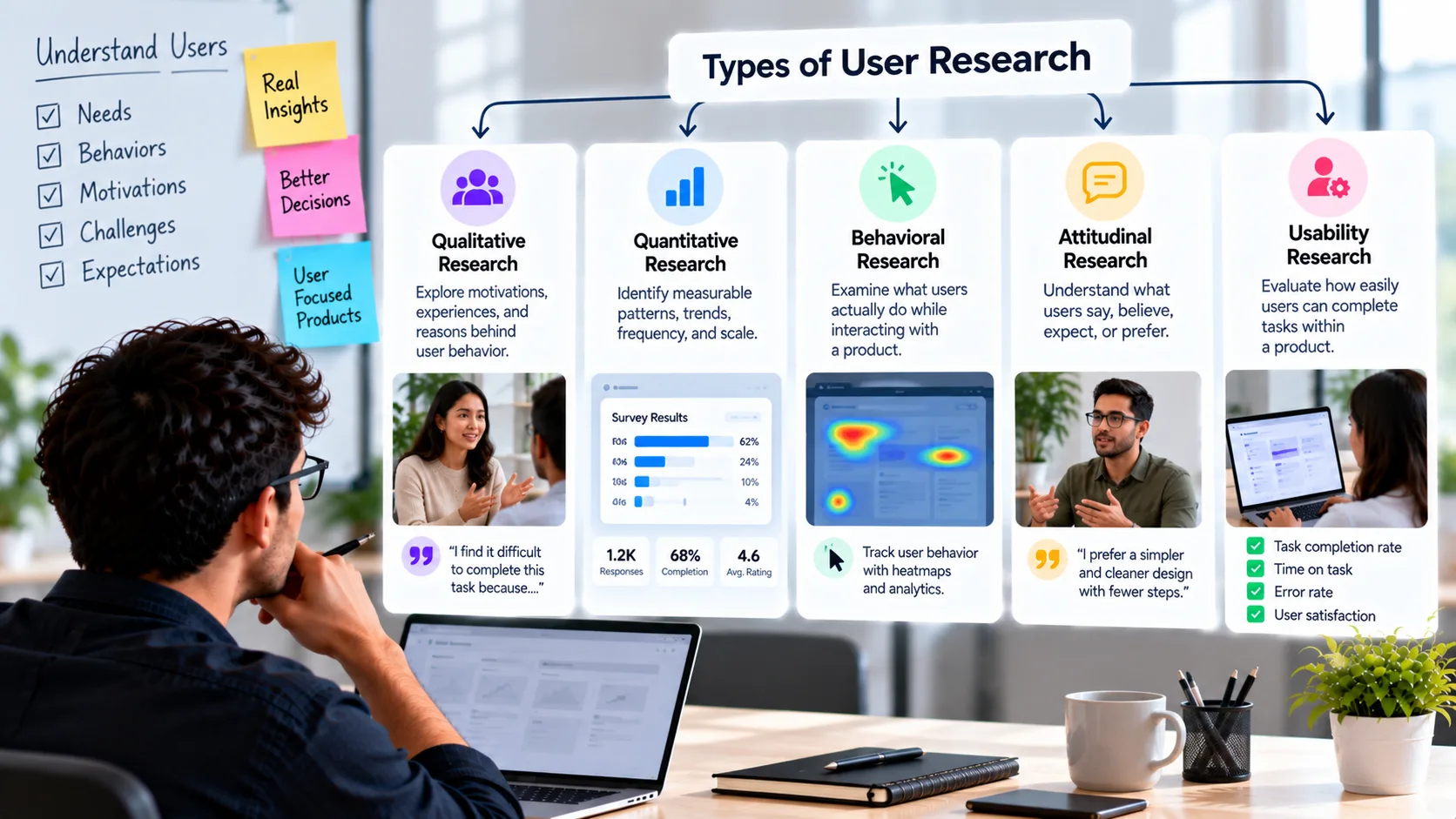
- Qualitative research: Explores motivations, experiences, perceptions, and reasons behind user behavior.
- Quantitative research: Identifies measurable patterns, trends, frequency, and scale.
- Behavioral research: Examines what users actually do while interacting with a product.
- Attitudinal research: Explores what users say, believe, expect, or prefer.
- Usability research: Evaluates how easily users can complete tasks within a product.
Combining different forms of research can provide a more complete understanding of the user experience and reduce the risk of making major decisions from a single source of information.
Why User Research Matters for Digital Products
Digital products often involve complex decisions. A business may need to determine which features to build, how information should be organized, how users should complete important tasks, or which problems deserve the most attention.
Without research, these decisions can be heavily influenced by assumptions. User research provides another perspective by bringing real user evidence into the process.
Research can also help teams identify problems earlier. Discovering that users do not understand a navigation structure during an early prototype is generally easier to address than discovering the same issue after the product has been fully developed.
- Reduce assumptions: Replace unsupported opinions with evidence from real users.
- Identify meaningful problems: Understand which challenges have the greatest impact on users.
- Improve product priorities: Use research findings to determine what deserves attention first.
- Strengthen UX/UI decisions: Design interfaces around real behaviors and expectations.
- Reduce unnecessary rework: Identify usability problems before they become expensive development changes.
- Improve long-term product direction: Continue learning as user needs and behaviors evolve.
Define What You Need to Learn
Effective user research begins with clear research objectives. Before selecting a research method, product teams should identify what they actually need to learn.
A broad statement such as “we want to understand our users” is not specific enough to guide meaningful research. Instead, define focused questions related to the decisions the team needs to make.
For example, if you are designing a new onboarding experience, you might want to understand why users abandon registration, what information they need before creating an account, or which steps they find confusing.
- Identify the product decision: Understand which decision the research is intended to support.
- Define the target users: Identify whose experiences are most relevant to the question.
- Write research questions: Turn uncertainty into specific questions that can be investigated.
- Identify assumptions: Document what the team currently believes and needs to validate.
- Define the desired outcome: Decide how research findings will influence the next product decision.
Clear research objectives prevent teams from collecting large amounts of information without a clear purpose. They also make it easier to select the right research method.
Choose the Right Research Methods
Different research methods answer different questions. Selecting the right approach depends on the product stage, research objective, available participants, timeline, and type of information required.
User interviews can provide detailed insight into motivations and experiences. Surveys can collect broader feedback. Usability testing can reveal where people struggle with a product. Analytics can show behavioral patterns at scale.
- User interviews: Useful for exploring goals, motivations, frustrations, and experiences in depth.
- Surveys: Useful for collecting structured responses from a larger audience.
- Usability testing: Useful for observing how users interact with an interface or prototype.
- Analytics: Useful for understanding measurable user behavior within an existing product.
- Customer feedback: Useful for identifying recurring problems, requests, and areas of dissatisfaction.
- Competitive research: Useful for understanding existing market experiences and user expectations.
- Contextual research: Useful for understanding how and where users actually perform tasks.
The best approach is not necessarily the most complicated one. A focused research method that answers the right question can be more valuable than a large research project without a clear objective.
Turn Research Insights into Product Decisions
Collecting research is only the beginning. The real value comes from turning findings into decisions that influence the product.
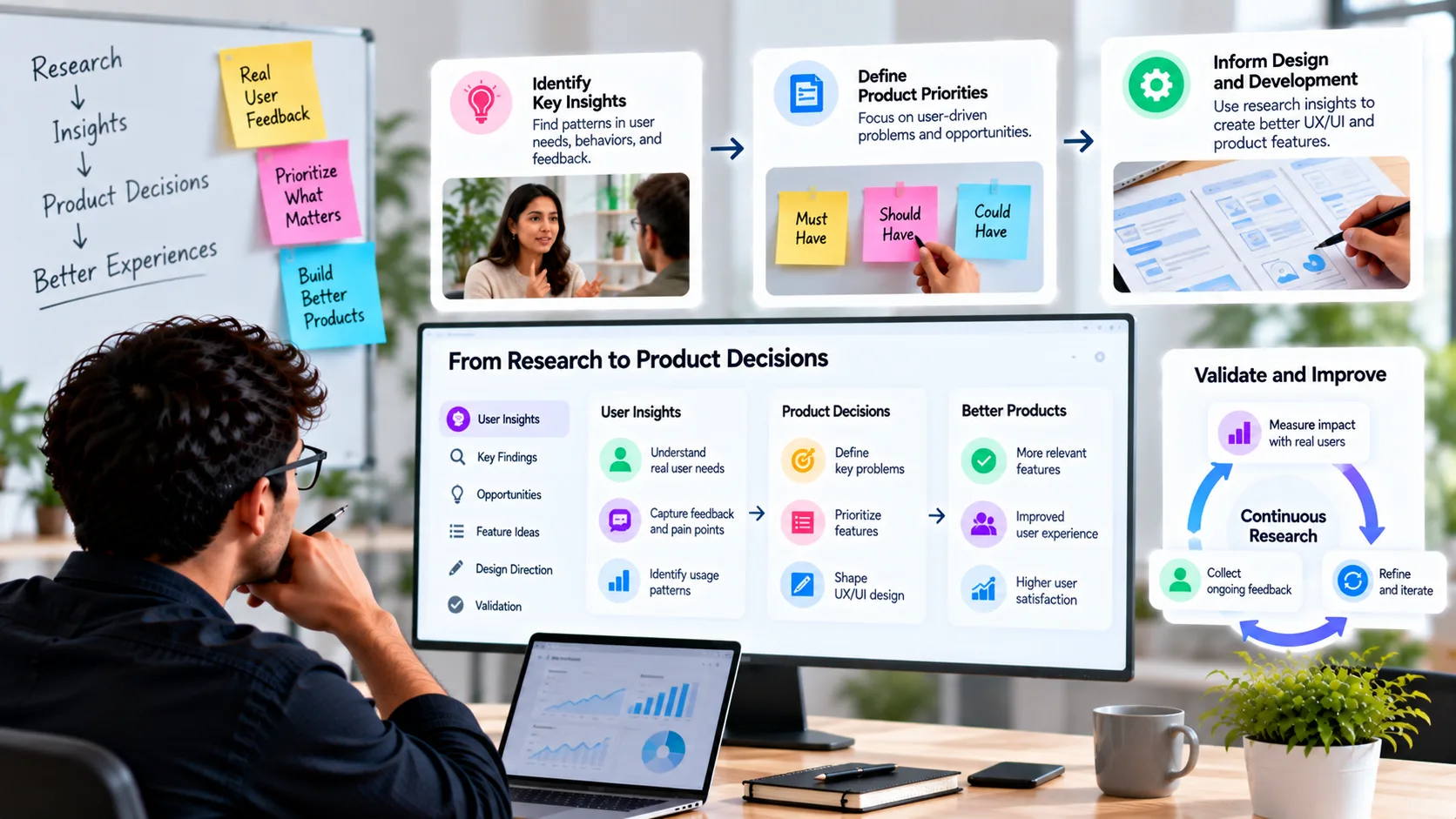
After research sessions or data collection, teams should identify recurring themes, important behaviors, unexpected findings, and significant pain points. These insights can then be organized and connected to specific product opportunities.
Not every piece of feedback should automatically become a feature. Research should help teams understand the underlying problem before deciding how to solve it.
- Identify patterns: Look for recurring behaviors and problems across multiple research sources.
- Separate symptoms from causes: Understand why a problem occurs rather than simply documenting what happened.
- Prioritize insights: Focus on findings that have meaningful implications for users and the business.
- Create opportunities: Translate important problems into possible product improvements.
- Connect findings to requirements: Use evidence to inform features, user flows, and experience decisions.
This creates a direct connection between user research and product strategy. Research becomes part of the decision-making process rather than a separate activity that ends once the report is delivered.
How Research Shapes UX/UI Design
User research has a direct influence on UX/UI design because it helps designers understand what users need from the experience. Research can affect everything from navigation and information architecture to content, interaction patterns, visual hierarchy, and interface components.
For example, research may reveal that users struggle to find an important feature. The design response might involve restructuring navigation rather than simply making the existing button more visually prominent.
Similarly, research may show that users are uncertain about what happens after completing an action. Designers can use this insight to improve feedback, confirmation states, messaging, and interaction patterns.
- Information architecture: Research can reveal how users expect information to be organized.
- Navigation: User behavior can identify confusing or inefficient paths through the product.
- Content: Research can reveal terminology and information users need to understand an action.
- Interaction design: Observations can influence how controls, forms, and workflows behave.
- Visual hierarchy: Research can help determine which information and actions need greater emphasis.
- Accessibility: Research can help identify different user contexts and interaction requirements.
Research therefore helps UX/UI designers move beyond personal preference and create interfaces that respond to real user needs.
Validate Designs with Real Users
Research should continue after initial discovery. Once UX/UI concepts, wireframes, or prototypes have been created, teams can return to users to test whether the proposed experience actually solves the identified problems.
Usability testing can reveal where users hesitate, misunderstand instructions, choose unexpected paths, or struggle to complete important tasks. These observations provide practical information that can be used to refine the design before development.
Testing does not need to involve a fully developed product. Interactive prototypes can simulate important journeys and provide enough realism to identify many usability issues.
- Define realistic tasks: Ask users to complete tasks that represent actual product goals.
- Observe behavior: Pay attention to what users do rather than relying only on verbal feedback.
- Identify friction: Record confusion, hesitation, errors, and unexpected navigation patterns.
- Prioritize findings: Focus on problems that significantly affect important user journeys.
- Iterate the design: Make improvements and test again when necessary.
Validation creates a feedback loop between users and designers. Instead of treating design as a one-time deliverable, teams can continuously refine the experience based on evidence.
Continue Research After Launch
A digital product does not stop changing when it launches. Real usage introduces information that may not have been available during the initial research and design stages.
Analytics can reveal how users actually navigate the product, while support conversations, reviews, surveys, and feedback can reveal problems users experience in real-world situations.
- Monitor behavioral data: Look for changes in engagement, navigation, conversion, and retention.
- Review feedback: Identify recurring problems and requests from real users.
- Run usability studies: Continue testing important journeys as the product evolves.
- Compare product changes: Evaluate whether design improvements produce the intended results.
- Research new user needs: Recognize when changing markets or audiences require new product decisions.
Continuous research helps product teams avoid treating the original research as permanent truth. Users, markets, technologies, and business requirements can change, so the product should continue learning from new evidence.
Common User Research Mistakes to Avoid
User research can become less effective when teams approach it as a formality rather than a decision-making tool. Avoiding common mistakes helps ensure that research produces useful product insights.
- Researching without a clear objective: Without a specific question, it can be difficult to determine what the research should reveal.
- Asking leading questions: Questions should allow users to explain their experiences without being pushed toward a preferred answer.
- Listening only to opinions: What users say they would do may differ from what they actually do. Behavioral observation is valuable.
- Using only internal feedback: Stakeholders and team members provide useful perspectives, but they are not substitutes for real users.
- Ignoring contradictory findings: Unexpected evidence can be valuable and should be investigated rather than dismissed.
- Collecting research without acting on it: Findings should influence product decisions, priorities, design, or strategy.
- Stopping research after launch: Real-world product usage can reveal new questions and opportunities.
The purpose of user research is not to prove that an existing idea is correct. Its purpose is to help teams discover what they need to understand so they can make better product decisions.
Conclusion
User research is one of the strongest foundations for creating meaningful digital product experiences. It helps teams move beyond assumptions and understand the people, behaviors, problems, and expectations that should influence product decisions.
From early product strategy and problem definition to UX/UI design, prototyping, usability testing, and post-launch optimization, research can provide valuable direction at every stage of the product lifecycle.
The most effective research is not research for research's sake. It is focused on meaningful questions and connected directly to decisions. When insights are translated into product requirements, user flows, interface improvements, and measurable outcomes, research becomes an active part of digital product development.
Start with curiosity. Ask the right questions. Observe real behavior. Validate important assumptions. Then keep learning after launch. By making user research a continuous part of product development, businesses can create digital experiences that are more relevant, usable, adaptable, and valuable over time.
Frequently Asked Questions
- What is user research in digital product design?
User research is the process of studying users, their behaviors, needs, goals, expectations, and challenges to inform digital product decisions. It can influence product strategy, UX/UI design, development priorities, and ongoing improvements. - Why is user research important for UX/UI design?
User research helps designers understand how people think, behave, and interact with digital products. These insights can guide information architecture, user flows, navigation, content, interactions, visual hierarchy, and interface decisions. - When should user research be conducted?
User research can be conducted throughout the product lifecycle. Early research can help define problems and requirements, while research during design can validate concepts and research after launch can reveal opportunities for ongoing improvement. - What are the most common user research methods?
Common methods include user interviews, surveys, usability testing, analytics analysis, customer feedback, contextual research, competitive research, and behavioral studies. The right method depends on the research question and product stage. - How does user research improve digital products?
Research can reveal usability problems, unmet needs, confusing workflows, and behavioral patterns. These insights help teams prioritize improvements and create experiences that are more closely aligned with real user needs. - Is user research necessary for small digital products?
The amount of research can vary depending on the project, but even small products can benefit from understanding their target users. Simple interviews, feedback sessions, prototype testing, or existing customer insights can provide useful direction. - How does user research influence product development?
Research can influence which features are prioritized, how user flows are structured, what requirements are defined, and which problems need to be solved first. It can also help development teams understand the purpose behind specific product requirements. - Should user research continue after a product launches?
Yes. Post-launch research can reveal how users actually interact with the product and identify problems or opportunities that were not visible during the initial design process. Analytics, feedback, usability testing, and customer conversations can all contribute to continuous improvement.

Insights | September, 2026
A Practical Guide to Building High-Performance Web Applications
Discover the key considerations for developing web applications that deliver reliable performance, scalable architecture, intuitive experiences, and long-term value.
Brandube

Insights | September, 2026
Designing Scalable Design Systems for Consistent Digital Experiences
Discover how a well-structured design system improves consistency, speeds up product design, and creates a more connected experience across digital platforms.
Brandube

Insights | September, 2026
What Makes a Successful Mobile App: UX, Performance, and Functionality
Explore the essential factors behind successful mobile apps, from intuitive UX and responsive performance to useful functionality and consistent experiences.