Discover how to transform a SaaS concept into a scalable digital product by combining user-focused design, reliable development, and a clear product strategy.

Table of Content
Overview Introduction Define the SaaS Product Vision Understand the Target Users Plan the MVP Scope Design the SaaS Product Experience Build a Scalable Technical Foundation Develop Secure and Reliable Features Plan for SaaS Scalability Test Before Launch Launch, Measure, and Improve Common SaaS Development Mistakes to Avoid Conclusion Frequently Asked QuestionsOverview
Building a SaaS product involves much more than developing software and putting it online. A successful SaaS product needs a clear purpose, a strong understanding of its users, an intuitive experience, reliable technology, and a product strategy that can evolve over time.
Unlike traditional software that may be installed and used as a fixed solution, SaaS products are continuously delivered through the internet. This means the product needs to support ongoing improvements, reliable access, secure data management, subscription or account workflows, and an experience that keeps users engaged over the long term.
The strongest SaaS products are built with both today's requirements and tomorrow's growth in mind. That does not mean building unnecessary complexity from the beginning. It means creating a practical foundation that can evolve as the product gains users, data, functionality, and market feedback.
Introduction
A SaaS product typically combines software, infrastructure, user experience, business logic, data, and ongoing product development into one connected service. Users expect the product to be accessible, responsive, secure, and continuously improved without having to manage the underlying technology themselves.
For founders and businesses, this creates both an opportunity and a challenge. A SaaS product can reach users across locations and grow continuously, but its success depends on decisions made long before launch.
The process should therefore begin with a clear product strategy. Instead of immediately building every feature, teams should identify the core problem, understand the people experiencing it, define the essential solution, and create a focused path from idea to launch.
Define the SaaS Product Vision
Every successful SaaS product begins with a clear understanding of the problem it is designed to solve. Before choosing technologies or creating interfaces, define what the product should accomplish and why users would choose it.
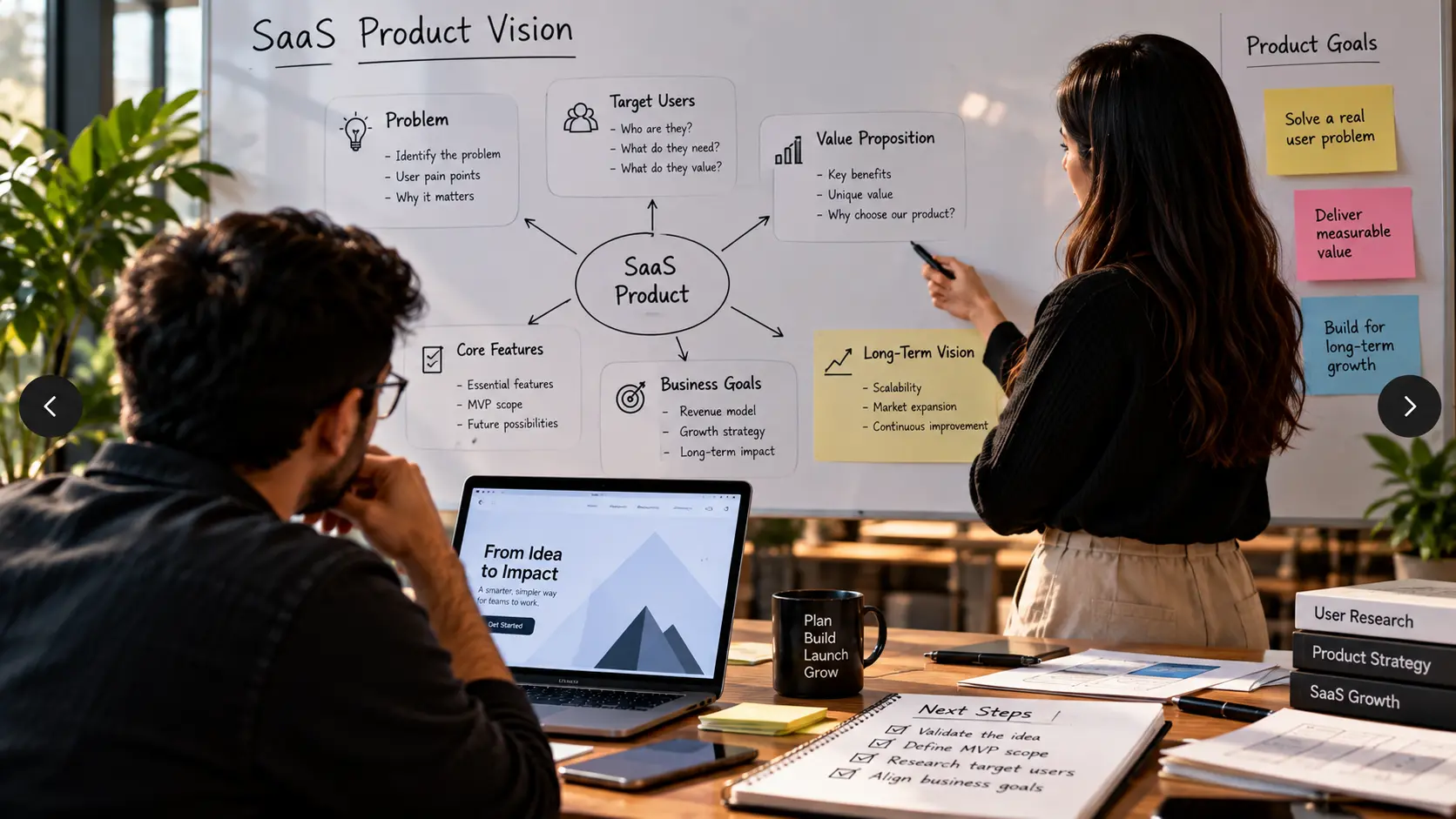
A strong product vision provides direction for design and development. It helps teams decide which features are essential, which ideas can wait, and how the product should evolve after launch.
- Define the problem: Identify the specific challenge the product is designed to address.
- Understand the value: Clearly explain what users gain from using the product.
- Identify the target market: Determine who the product is designed for and what they need.
- Define the core outcome: Establish what successful product usage should help users achieve.
- Set product goals: Connect product development with measurable business objectives.
A clear vision keeps the product focused and prevents development from becoming a collection of disconnected features.
Understand the Target Users
SaaS products succeed when they solve meaningful problems for real users. Understanding those users should therefore be a central part of product planning.
Research how potential users currently solve the problem, what frustrates them, what they value, and what prevents them from adopting better solutions. These insights can influence everything from product functionality to navigation, onboarding, pricing, and support.
User research does not need to be complicated. Interviews, surveys, competitor analysis, usability observations, customer conversations, and behavioral data can all provide useful information.
- Identify user needs: Understand the problems and goals that matter most to the target audience.
- Map user workflows: Understand how users currently complete important tasks.
- Identify pain points: Discover where existing solutions create friction or inefficiency.
- Understand expectations: Learn what users expect from modern digital experiences.
- Validate assumptions: Use research to test product ideas before investing heavily in development.
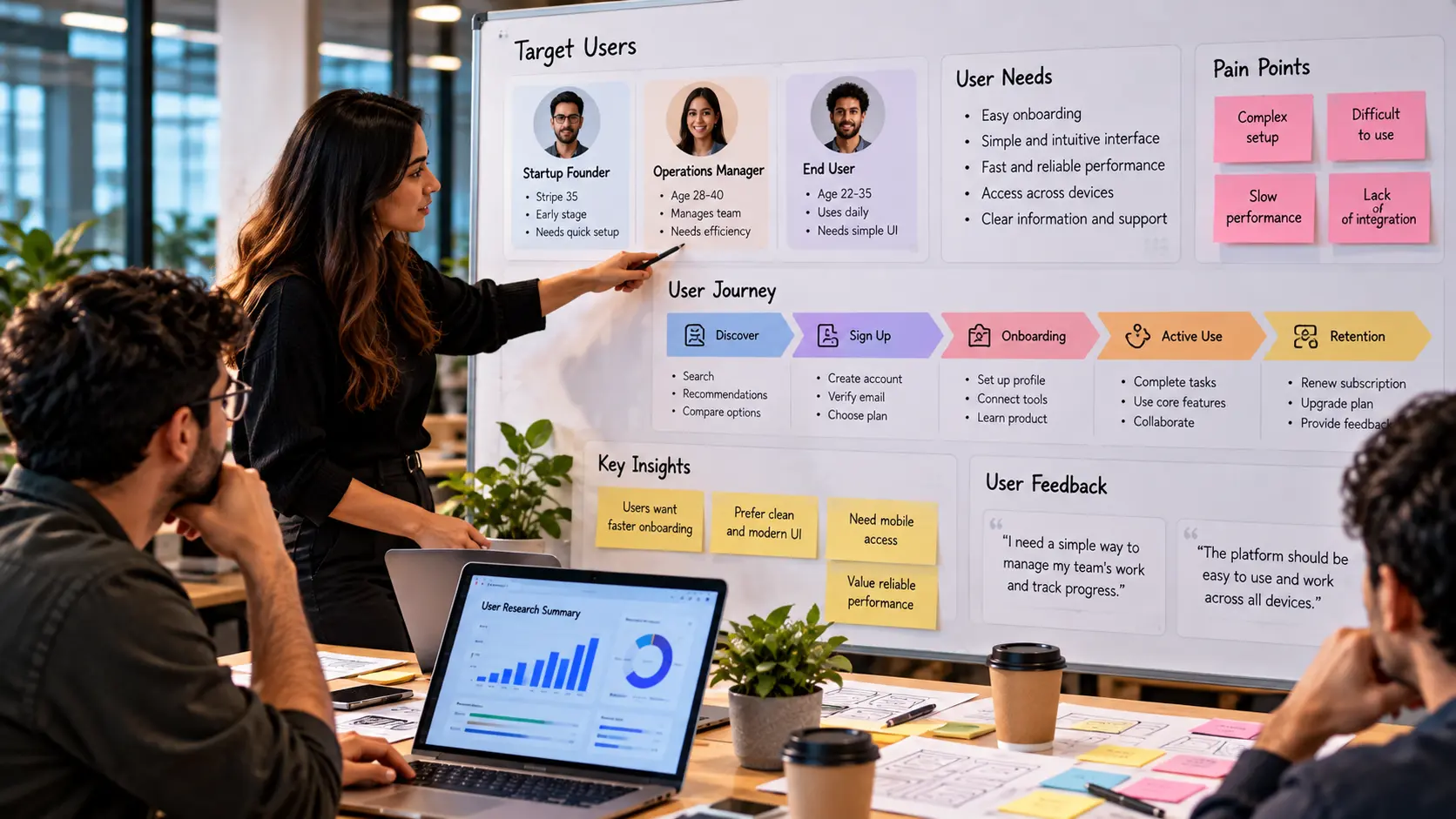
The more clearly the team understands its users, the easier it becomes to prioritize meaningful product functionality.
Plan the MVP Scope
A minimum viable product should focus on the smallest practical version of the solution that can deliver meaningful value and generate useful feedback.
The goal of an MVP is not to create an incomplete product. It is to avoid spending excessive time and resources building functionality before there is evidence that users need it.
Start by identifying the essential user journey. What does a user need to do from the moment they enter the product to the moment they achieve the intended outcome? Build around that core journey first.
- Prioritize essential features: Focus development on functionality directly connected to the core product value.
- Remove unnecessary complexity: Defer features that are not essential to initial validation.
- Define the core user journey: Make the primary workflow clear and easy to complete.
- Set realistic launch criteria: Define what must be ready before the product can be released.
- Plan future iterations: Keep a clear backlog for improvements based on user feedback.
Design the SaaS Product Experience
Good SaaS products should make complex tasks feel clear and manageable. UX/UI design plays an important role in helping users understand the product, navigate its functionality, and complete important tasks efficiently.
Begin with the information architecture and user flows. Determine how features should be organized and how users will move through the product. From there, wireframes and prototypes can help validate the experience before development begins.
The interface should also provide clear feedback. Users need to understand what is happening when they submit information, complete a task, encounter an error, or wait for a process to finish.
- Clear navigation: Organize functionality so users can quickly find what they need.
- Focused interfaces: Avoid unnecessary visual and functional complexity.
- Useful feedback: Clearly communicate actions, errors, progress, and completed tasks.
- Responsive experiences: Make the product practical across relevant screen sizes and devices.
- Consistent design: Use reusable patterns and components to create a connected product experience.
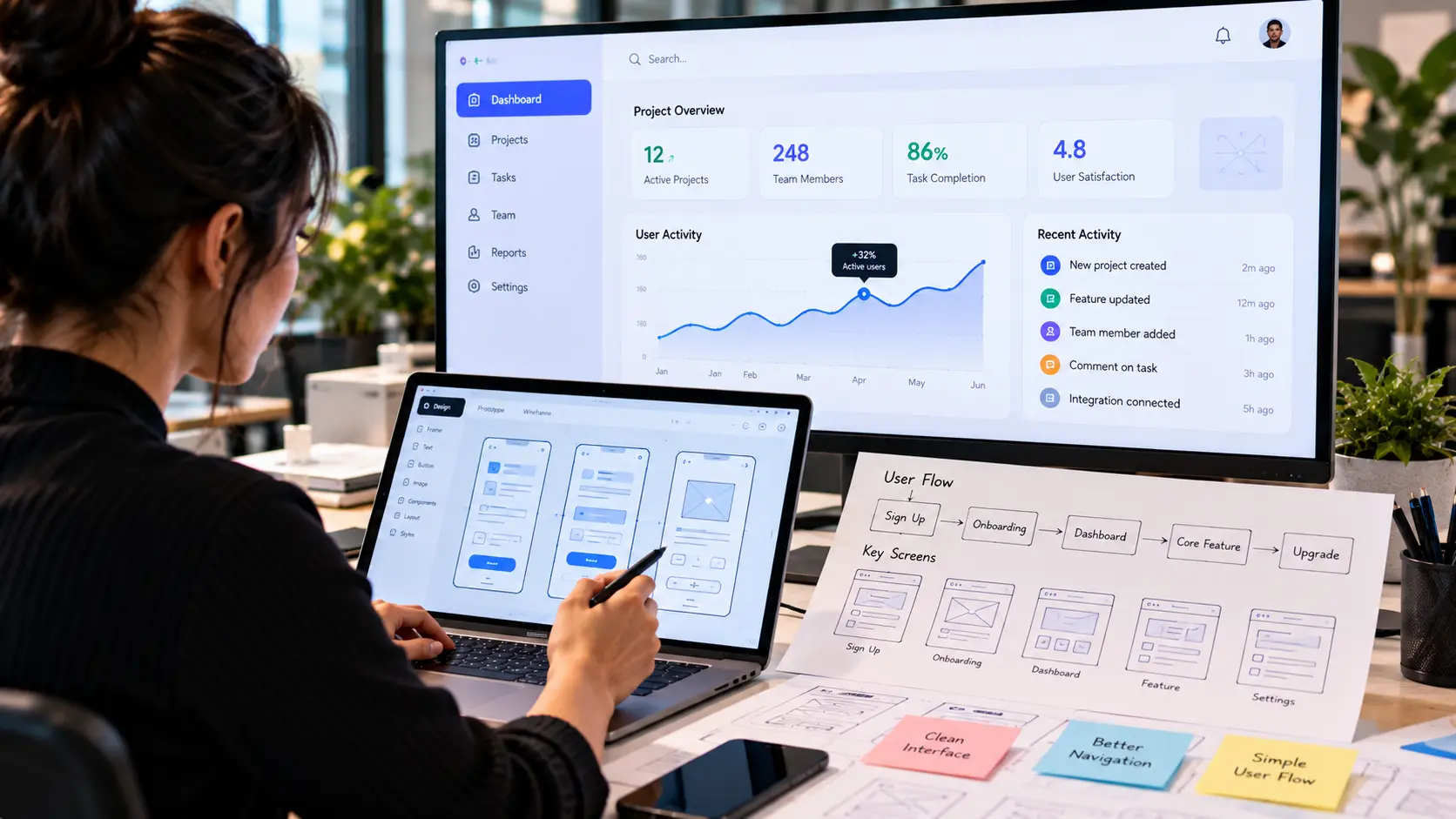
Design should continue throughout the product lifecycle rather than being treated as a one-time phase before development.
Build a Scalable Technical Foundation
The technology architecture behind a SaaS product needs to support the current product while providing a practical path for future growth.
This includes the frontend, backend, database, APIs, authentication, infrastructure, deployment processes, monitoring, and other technical systems required to operate the product.
Scalability does not mean creating the most complex architecture possible from day one. Over-engineering an early product can increase development time, operating costs, and maintenance effort.
Instead, build a clean and maintainable foundation that can evolve as product requirements become clearer. The architecture should make it possible to introduce new functionality without constantly rebuilding the core system.
- Choose appropriate technologies: Select a technology stack based on product requirements rather than trends.
- Separate key responsibilities: Maintain clear boundaries between different application layers.
- Plan for data growth: Consider how data volume and usage may increase over time.
- Build reusable components: Create technical foundations that support future development.
- Establish reliable deployment: Make releases predictable and manageable as development continues.
Develop Secure and Reliable Features
Security and reliability should be considered from the beginning of SaaS development. SaaS products often handle user accounts, business information, payment data, documents, communications, and other valuable information.
Authentication and authorization should be designed carefully so users can access only the information and functionality appropriate to their accounts and roles.
The application should also be designed to handle errors gracefully. Monitoring, logging, backups, recovery procedures, and appropriate testing can help identify problems and reduce their impact.
- Secure authentication: Protect user accounts with appropriate authentication practices.
- Access control: Ensure users can access only authorized resources and functionality.
- Data protection: Protect sensitive information during storage and transmission.
- Reliable infrastructure: Use appropriate monitoring, backups, and recovery processes.
- Dependency management: Keep frameworks, libraries, and third-party services maintained.
Plan for SaaS Scalability
As a SaaS product gains users, its requirements can change significantly. More users can mean more requests, more data, more transactions, more support requirements, and greater infrastructure demands.
Scalability should therefore be considered across the entire product, not only at the server level. Database performance, application architecture, APIs, frontend performance, infrastructure, monitoring, and development processes can all influence how effectively a SaaS product grows.
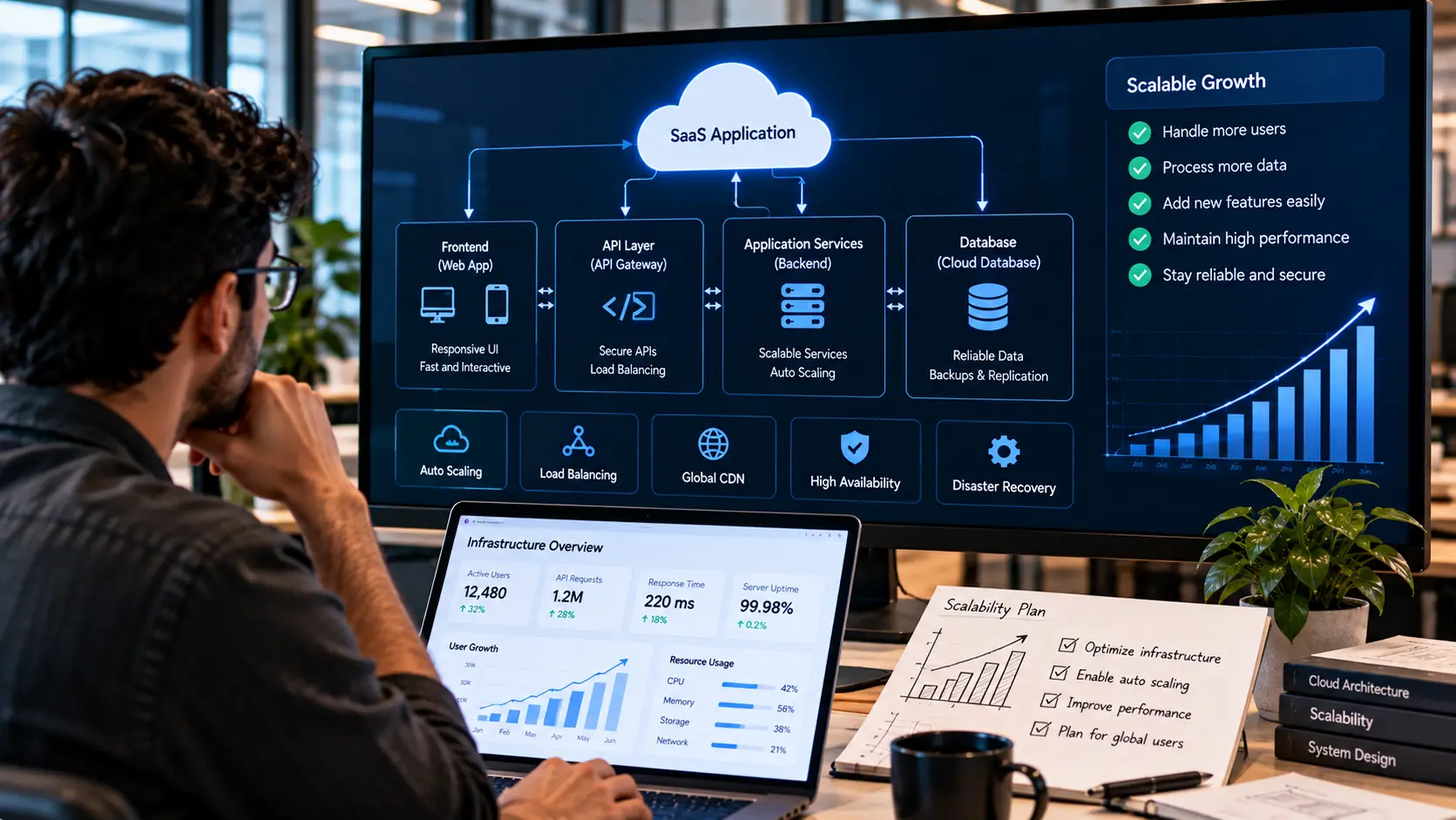
It is also important to distinguish between expected growth and hypothetical growth. Building for realistic requirements allows the team to remain efficient while keeping a clear path toward future expansion.
- Monitor application performance: Track how the product behaves as usage increases.
- Optimize database operations: Identify inefficient queries and data access patterns.
- Improve infrastructure capacity: Increase resources as actual usage requires them.
- Design for modular growth: Keep the architecture flexible enough for new features and services.
- Monitor user behavior: Understand which features and workflows are creating increasing demand.
Test Before Launch
A SaaS product needs to work reliably under the conditions users will actually experience. Testing should therefore cover more than whether individual features function correctly.
Usability testing can reveal confusing workflows, while performance testing can identify slow responses and resource limitations. Security testing can uncover vulnerabilities, and compatibility testing can verify that the product behaves correctly across relevant devices and environments.
- Functional testing: Verify that core features behave as expected.
- Usability testing: Observe real users completing important workflows.
- Performance testing: Evaluate response times and system behavior under expected loads.
- Security testing: Identify potential vulnerabilities and access-control issues.
- Compatibility testing: Test relevant browsers, devices, operating systems, and environments.
- Regression testing: Make sure new changes do not unintentionally break existing functionality.
Testing should continue after launch as new features, integrations, and infrastructure changes are introduced.
Launch, Measure, and Improve
Launching a SaaS product is the beginning of the product lifecycle, not the end. Once real users begin interacting with the product, the team gains access to information that cannot be fully replicated during development.
Track meaningful product metrics and collect qualitative feedback. Look at how users navigate the product, where they stop, which features they use, what problems they report, and what outcomes they achieve.
These insights can inform future product decisions. Instead of adding features based only on assumptions, teams can prioritize improvements based on actual user needs and product behavior.
- Measure activation: Understand whether new users reach the product's core value.
- Track engagement: Identify how users interact with important features over time.
- Monitor retention: Understand whether users continue finding value in the product.
- Collect feedback: Combine user feedback with behavioral data.
- Continuously improve: Use insights to guide new features, optimization, and product refinement.
Common SaaS Development Mistakes to Avoid
SaaS development can become unnecessarily difficult when teams focus too heavily on building features before validating the product's core value.
- Building too many features: A large feature set can increase complexity without improving the core user experience.
- Ignoring user research: Development based entirely on assumptions can result in features users do not need.
- Over-engineering the architecture: Excessive technical complexity can slow down early product development.
- Neglecting UX: Strong technology cannot compensate for a confusing product experience.
- Ignoring security: Security should be part of the architecture rather than a final development task.
- Launching without measurement: Without meaningful product data, it becomes harder to identify what should improve.
- Treating launch as the finish line: SaaS products require ongoing development, maintenance, optimization, and support.
The goal is to build a focused product, learn from real usage, and improve continuously rather than trying to predict every requirement before launch.
Conclusion
Building a scalable SaaS product requires a balance between product strategy, user experience, technology, and continuous development. A strong SaaS product starts with a meaningful problem and a clear understanding of the users who experience it.
From defining the product vision and planning the MVP to designing the experience, building a reliable technical foundation, testing the product, and learning from real users, every stage contributes to the long-term quality of the product.
Scalability should not mean unnecessary complexity. It means creating a foundation that can grow as the product gains users, data, functionality, and market understanding.
When design, development, and product strategy work together, a SaaS idea can evolve into a reliable digital product that continues to create value long after its initial launch.
Frequently Asked Questions
- What is a SaaS product?
A SaaS product is software delivered as an online service, allowing users to access its functionality through the internet without managing the underlying software infrastructure themselves. - How do I start building a SaaS product?
Start by identifying a clear problem, understanding the target users, defining the product value, validating the idea, and prioritizing the essential functionality for an initial MVP. - What should a SaaS MVP include?
A SaaS MVP should include the smallest practical set of features needed to deliver the product's core value and allow the team to learn from real users. - Why is UX important for SaaS products?
Good UX helps users understand the product, navigate its functionality, complete tasks efficiently, and continue finding value in the service. - How can a SaaS product be designed for scalability?
Use a maintainable architecture, appropriate technologies, efficient data structures, reliable infrastructure, monitoring, and a development approach that allows the product to evolve as usage increases. - Should scalability be planned from the beginning?
Yes, but it should be balanced with the product's actual requirements. The goal is to create a foundation that can grow without introducing unnecessary complexity too early. - What should be tested before launching a SaaS product?
Important areas include functionality, usability, performance, security, compatibility, reliability, and the core user journeys that determine whether users can achieve the intended outcome. - Does a SaaS product require ongoing development?
Yes. SaaS products typically require continuous maintenance, performance improvements, security updates, new features, user experience improvements, and product refinement based on feedback and data.

Insights | September, 2026
Designing Scalable Design Systems for Consistent Digital Experiences
Discover how a well-structured design system improves consistency, speeds up product design, and creates a more connected experience across digital platforms.
Brandube
Insights | September, 2026
A Practical Guide to Building High-Performance Web Applications
Discover the key considerations for developing web applications that deliver reliable performance, scalable architecture, intuitive experiences, and long-term value.
Brandube

Insights | September, 2026
From Wireframes to Prototypes: A Practical Guide to Product Design
Learn how wireframes and prototypes transform early product ideas into clear, testable experiences while reducing design and development uncertainty.